 Intro
Intro
Welcome back to Path to Glory for another warband review, this time for Kamandora’s Blades, the newest Chaos warband to jump into the Underworlds! Before we start, I again would like to thank Games Workshop for providing us with this free review copy.
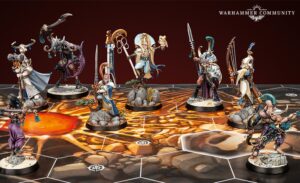
While I am still not-so-patiently waiting for a new Death warband, Chaos is probably my second favorite Grand Alliance, so I won’t complain too much this time. The elephant in the room on these guys is definitely the concern over the quality of the sculpts. When GW first previewed them, there was a lot of disappointment over how they looked, and I have to say I was definitely a good bit of the way into that camp. While there are certainly elements of the models/poses that I enjoy, the whole no lips thing I just find really off-putting, as I think it distracts from the more interesting aspects of the minis. Mechanically, you probably won’t be surprised to hear that a Khorne warband is labeled as Strike—Blood for the Blood God, Skulls for the Skull Throne, etc.—but let’s get into what might make them unique from other Strike warbands we might have seen previously.
Warscroll
Inspire, A Worthy Skull, and Slaughterous Pilgrimage


Since these abilities all only interact with each other, we’ll discuss them in tandem. To inspire a fighter, they either need to be adjacent to the worthy skull at the end of a power step or they have to slay the worthy skull. At the start of the first action step of every round, you pick one enemy fighter (assuming there is at least one on the battlefield) to be the worthy skull, so you actually have a decent bit of control over where your source of inspiration is coming from and can apply some pressure to your opponent regarding how cautiously they might decide to play that fighter. After picking the worthy skull, you must push each friendly fighter 1 hex towards that fighter with Slaughterous Pilgrimage. This ability is absolutely bonkers in the first round, granting you 5 (albeit directionally limited) free pushes. At minimum, given the new boards, this should make it incredibly difficult to not have 4 solid charges lined up for the round right off the bat, and is a particularly scary prospect for warbands which operate around a single linchpin fighter such as Grymwatch or Sepulchral Guard. Additionally, this ability notably lacks any restrictions about landing on feature tokens. Even if you’re not playing for any token-centric scoring yourself, mindful token placement should let you hop on 2 tokens immediately in a lot of instances, perhaps even 3 in niche cases, which will make it a lot harder for your opponent to squat those tokens themselves. We saw this kind of thing happen a lot with Hedkrakka’s Madmob in first edition and it will be just as good, if not better, in the first round here. The downside will likely be in the later rounds, as you don’t always want to push all of your fighters. Once the action of the first round settles and fighters are a bit more scattered to the wind, it will often be difficult to pick a single enemy fighter that will push all of your fighters in a favorable direction. Additionally, if you are playing for a more token-centric strategy, any work you did in the prior round to set up your scoring is pretty much undone, as you just have to hop off those tokens en masse at the beginning of the round. Still, being branded as a Strike warband, the most straightforward uses of the ability will be good ones, which are to more easily access charges, set up attacks which don’t require a charge, and/or set up flanked and surrounded attacks for better odds of hitting. Overall, there’s a lot of power locked up in this ability, and identification of the right worthy skull can offer a lot of aggro upside, flex potential, and even positional control.
Blood for Khorne!

You’ll notice the “slashing” runemark on the weapon profiles for the warband and thankfully your confusion about what it does will end here! When you hit someone with an attack while using this runemark, they get a bleed token, which will deal that fighter a point of damage after they resolve a core ability. Notably, the token clears after your opponent’s power step (or after the round ends). While clearly a downgrade from grievous, which will offer more immediate and consistent payout, I’ll certainly take this over having no runemark (and even some non-grievous runemarks, depending on the circumstances). Outside of potentially augmenting the warband’s damage output to help secure more kills, this is yet another little element of control in their arsenal. While there will certainly be situations where it is obvious which fighter your opponent plans to use in the next action step (e.g., if all but one of their fighters have charge tokens), this will particularly reward players who are good at identifying their opponent’s best options even in more fluid board/game states. While it is difficult to list off all of the different indicators about what your opponent is planning to do in their next action step, my general advice would be to think about what it is they are trying to score with their deck. Will they need to delve another token, hold another treasure, make another charge? As usual, having a strong understanding of which objectives your opponent is playing for grants you the best opportunity to deny them or, in this case, profit via extra damage. Sometimes even leaving an enemy vulnerable after your attack with the bleed token on them might, by default, remove the option for your opponent to do anything meaningful with that fighter next turn since they would die afterwards. While not quite as flashy as the prior ability, still a good bit of technical play here, which is something I always appreciate in my Strike warbands.
Call the Pursuit

The last ability on the warscroll, Call the Pursuit is a once-per-game ability in the power step to push Kannat up to 4 hexes ending adjacent to your leader. Given that two particular fighters need to be alive to use this, I think you’re probably using it in the first round quite often. Whether to force out an inspiration by pushing up against the worthy skull or simply to set up a flanked attack, pushes almost always have some decent utility, especially when they’re coming from a warscroll. Still, the fighter limitations on this will be felt quite often, I think, if for no other reason than the fragility of Kamandora meaning she’ll frequently be deploying in your mid-to-back line. If PnP ends up being the way to go with this warband, perhaps the better option is simply to push the dog onto a token next to her instead and get delving.
Fighters


As usual, we’ll start with the leader, who continues a sad trend of 2-Bounty, 3-Health fighters, although she at least starts the game on 2 Dodge. She also has a Move characteristic of 4 and a decent attack profile of 1R/2H/2D with slashing. In conjunction with the push from Slaughterous Pilgrimage, you can pretty much deliver that attack wherever you want in the first round, but the mobility also enables you to deploy her a bit safer and still be within striking distance. When she inspires, she only gains +1 Dice on her melee profile which, while a nice boon, does actually make her inspiration a bit lower priority than that of other fighters in the warband.


Speaking of important inspirations, our next fighter is the axe-wielding Throkk, who sports a physical profile of 4 Move, 1 Dodge, 4 Health and 2 Bounty and carries the same weapon profile as your leader at 1R/2H/2D with slashing. Once inspired, he is actually strictly better, gain +1 Dice both on his attack and his Save characteristic. While he is a perfectly respectable fighter, I think I would have traded 1 hex of movement to start off with grievous instead of slashing, which I think would be perfectly fitting for this model given his weapon choice when compared to the rest of the warband. I would also have liked to see this for your leader’s sake as, when they are both inspired, Throkk is just strictly better, which feels wrong to me. In any case, probably one of your highest priority inspires here, but you do need to be mindful about how you approach his inspiration since you don’t want to end up overexposed and lose one of your most important pieces as a result.


I’ll cover Ghalista and Antro Krast in the same breath here since they are exactly the same on their fighter cards. Both start at 4 Move, 1 Dodge, 3 Health and 1 Bounty with 1R/3S/1D attacks with slashing, then inspire to 2 Dodge and their attack profiles improve to 1R/4S/2D with slashing. Some pretty serious benefits to inspiring these two, so I think you’ll probably not mind throwing their attacks out at the worthy skull early in the round. If they hit, great, if they whiff, at least they likely will be getting inspired. If you have some guard tech in your deck (which does play nicely with the warband), you can even apply a lot of pressure to the worthy skull early in the game simply by standing next to them on-guard. This can potentially force your opponent to burn push or teleport tech early, or even to activate that fighter before they would normally prefer to do so. If that’s the plan, I would say these two are the best suited in the warband for the task.


Last, and least in this case, we have Kannat at 4 Move, 1 Dodge, 2 Health, and 1 Bounty with a miserable 1R/2S/1D with slashing. Inspired, he’s not that much better off despite gaining +1 Dice on his Save and his attack. That being said, you’ve got plenty of flexibility in terms of offensive output with the rest of the warband—once they are inspired at least—that you don’t mind the dog being a bit more of a positional piece. He’s never going to be the star of the show, but using him to secure your positional scoring is about all he needs to do for you, especially if that forces your opponent to deal with him in lieu of pursuing kills on your more critical offensive pieces.
Conclusion
While I, like many of you, am a bit concerned about the sculpts for this warband (I still think some head swaps might be in order), I am actually very excited for them mechanically. I love a good “thinking man’s aggro” and I think that’s exactly what we have here. The warband has access to some great positional control with Slaughterous Pilgrimage as well as fighter control with Blood for Khorne! They also don’t have the raw stats to just brawl with many warbands in the middle of the board, so they’ll definitely reward savvier play than your run-of-the-mill ABC aggro team. While Kamandora or Throkk are your most potent early-game offensive threats, I like the flexibility of being able to load up one of the “twins” if things go sideways for them without giving up too much in terms of power level (assuming you’ve gotten them inspired).

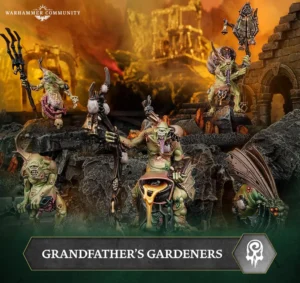
As far as deck pairings, it’s hard not to like the idea of PnP with most warbands, and the potential immediacy of pushing onto tokens to start delving right away is very attractive. If you want them, there are also two teleports and two pushes in that deck to help you set up some inspirations. It’s difficult to ignore my typical inclination to just run BA x PnP with them and call it a day. Double guard ploys, multiple teleports, great accuracy and grievous support are all just tough to pass up these days. That said, I think they also have some fun lines available with Realmstone Raiders or Raging Slayers. Unlike some Strike warbands, I can see a world where you don’t just automatically reach for Blazing Assault right off the bat since they do pack in a decent amount of their own mobility and, when inspired, their own accuracy. To be honest, the only thing I would say is less than ideal for them is trying to hold treasure tokens since you will be pushing off all of them at the beginning of the second and third rounds. While I’m not inclined to yield to GW’s archetype descriptions, I think this is actually more of a “Mastery” warband masquerading as a Strike warband. While they can certainly do the Strike thing, I think there’s a lot more here than many of those warbands are capable of if you are able to find the lines. I have to hand it to the designers, the balance among the brand-new V2 warbands has generally been very good. While you might say Jaws and Gardeners have been very strong, they’ve not been meta-defining like some of the re-done V1 warbands. However, each of the weaker new warbands has still maintained a level of competitive viability, and I think that will continue to be the case here.
Well, that’s all for this one. Please let us know if you agree, disagree, and/or are excited to see this warband join us in Embergard. Until next time, we wish you the best of luck on YOUR (bloody) Path to Glory!